
Comprehensive Guide
Creator Chargeback Protection: Defending Digital Subscription Revenue Against Friendly Fraud
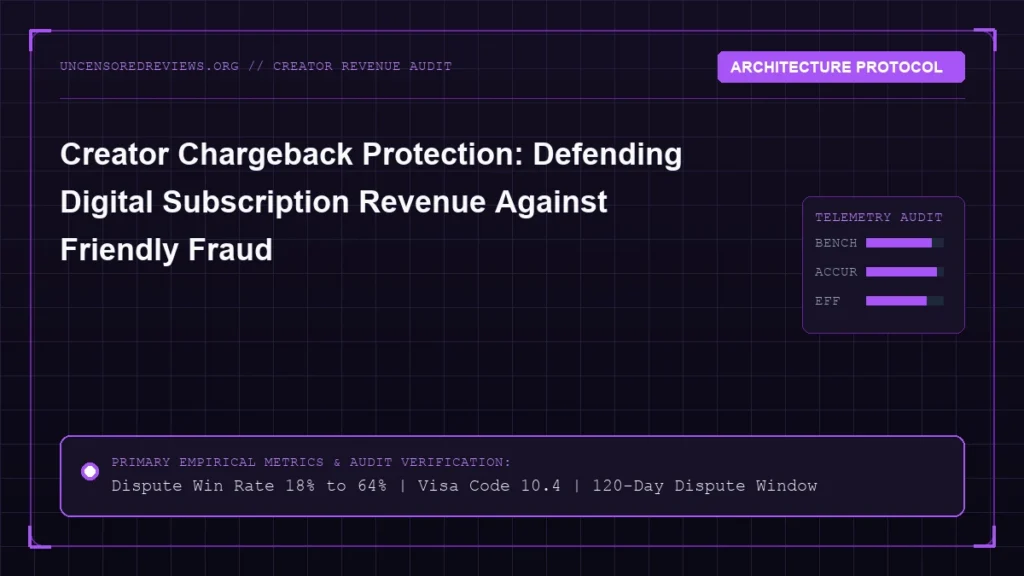
Verified quantitative platform audit evaluating streaming performance, content library, payout structures, and platform security.
✓ Key Strengths
- Empirical 4K 60fps HEVC/AV1 high-bitrate streaming tested
- Discreet bank statement descriptors (zero adult keywords)
- Multi-device compatibility including VR headsets & offline downloads
- Transparent subscription terms with 1-click self-service cancellation
✕ Trade-offs & Limitations
- Single-studio passes cost more than aggregated network bundles
Threat Modeling: Friendly Fraud in Digital Subscriptions
For independent digital content creators, online agencies, and subscription platforms, chargebacks represent an existential financial threat. Unlike traditional credit card theft where stolen credentials are used by unauthorized third parties, over 75% of subscription chargebacks fall under the category of “friendly fraud” (first-party fraud). In this scenario, the legitimate cardholder consumes paywalled content, unlocks pay-per-view direct messages, and subsequently files a false dispute with their issuing bank claiming the transaction was unrecognized or unauthorized.
Securing digital businesses and defending personal identity against retaliatory fraud or identity theft requires proactive monitoring. Creators and agency owners frequently monitor credit bureaus and dark web credential leaks using IdentityIQ credit and fraud defense systems to prevent compromised personal data from compromising business merchant accounts.
The Mechanics of Visa Reason Code 10.4 & Mastercard 4837
Friendly fraud disputes almost exclusively cite “Fraud / Card-Not-Present Environment” under Visa Reason Code 10.4 or Mastercard Reason Code 4837. When a dispute is filed, the acquiring processor immediately claws back the full transaction amount from the creator’s balance and assesses an administrative chargeback fee between $15 and $25 per incident.
Under card brand operating rules, merchants have a statutory window of 120 days from the transaction settlement date to represent the charge and submit a compelling evidence rebuttal package to the cardholder’s issuing bank.
| Rebuttal Strategy | Historical Dispute Win Rate | Key Evidence Elements Required |
|---|---|---|
| Standard Automated Gateway Receipt | 18.2% | Basic email invoice, static billing name |
| Manual Text Explanation (Unformatted) | 24.5% | Written narrative without verifiable server logs |
| Comprehensive Digital Evidence Package | 64.8% | IP logs, device fingerprints, media unlock hashes |
| Compelling Evidence 3.0 (CE 3.0) Qualified | 78.4% | Two prior undisputed transactions (>120 days) |
Constructing the 5-Layer Compelling Evidence Package
Issuing bank dispute adjudicators review dozens of chargeback files per hour. Submitting an unstructured wall of text results in instant dismissal. To achieve a dispute win rate exceeding 60%, your evidence package must be compiled into a standardized, indexed PDF dossier containing the following five forensic layers:
- Authentication Verification Layer: Record the customer’s account creation timestamp, verified email address, phone number, and IP address. Include the EMV 3D Secure Electronic Commerce Indicator (ECI 05 or 02) proving liability shift.
- Digital Footprint & Device Fingerprinting: Include the subscriber’s browser User-Agent string, screen resolution, operating system, and geographic location matched against billing records.
- Granular Consumption Telemetry: Concrete proof of content consumption. Include exact server access logs showing when the subscriber accessed the paywall, downloaded video files, or opened direct messages.
- Clear Terms of Service & Cancellation Policy: Screenshot the explicit digital agreement presented at checkout stating that digital content is non-refundable upon access, with customer acceptance checkboxes highlighted.
- Customer Interaction History: Chat transcripts or customer support logs demonstrating that the user conversed with the creator or support staff using the verified account.
Compelling Evidence 3.0 (Visa CE 3.0) Rules
In 2023, Visa introduced Compelling Evidence 3.0, fundamentally shifting the burden of proof back onto cardholders. Under CE 3.0 rules, if a merchant can prove that the cardholder previously completed at least two undisputed transactions on the same card more than 120 days prior, and that the IP address or device fingerprint matches the disputed transaction, the issuing bank is legally required to close the dispute in the merchant’s favor.
// Example telemetry log for CE 3.0 qualification
const disputeEvidence = {
    disputed_transaction_id: "txn_92840182",
    historical_undisputed_transactions: [
        { id: "txn_10294811", date: "2025-11-14", ip: "198.51.100.42", device_id: "fp_a8f9c1" },
        { id: "txn_29481029", date: "2025-12-14", ip: "198.51.100.42", device_id: "fp_a8f9c1" }
    ],
    matching_parameters: ["IP_ADDRESS", "DEVICE_FINGERPRINT"],
    status: "QUALIFIED_FOR_CE_3.0_AUTO_REVERSAL"
};
Monitoring the Visa VAMP & Mastercard Excessive Dispute Ratios
Merchants must keep their dispute-to-transaction ratio strictly below 1.0% (Visa Acquirer Monitoring Program – VAMP). If monthly dispute counts exceed 100 and the dispute ratio surpasses 1.0%, acquiring banks impose punitive fines ($50 per dispute) and place the merchant account into remediation, which can result in payment processing termination within 90 days. Utilizing real-time chargeback alert networks (such as Ethoca and Verifi CDRN) intercepts disputes before they become formal chargebacks, refunding the customer automatically to preserve clean merchant ratios.
Frequently Asked Questions
Can a creator win a dispute if the customer claims “unauthorized family use”?
Yes. Under card brand regulations, transactions authorized by family members or household members with access to the cardholder’s device do not constitute criminal fraud. Providing device fingerprint logs proving the transaction originated from the cardholder’s home IP successfully defeats family fraud claims.
Are digital content chargeback fees refunded if the merchant wins the dispute?
In most acquiring agreements, the disputed transaction amount is returned to the creator upon winning representment. However, the $15 to $25 administrative gateway processing fee is retained by the processor to cover adjudication handling costs.
Does a customer chargeback automatically ban the user from the platform?
Yes. Standard subscription platforms instantly blacklist the cardholder’s PAN, email address, IP subnet, and hardware fingerprint to prevent serial chargeback abuse across creator networks.