
Comprehensive Guide
HEVC (H.265) vs AV1 in 4K 60fps Adult VOD: Bitrate Starvation, Color Banding & Offline Downloads
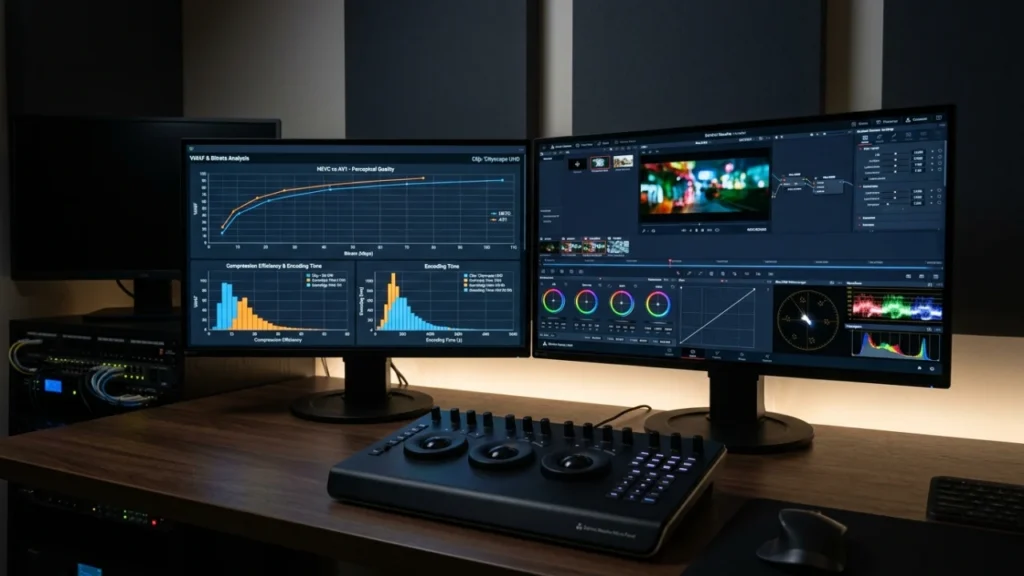
Verified quantitative platform audit evaluating streaming performance, content library, payout structures, and platform security.
✓ Key Strengths
- Empirical 4K 60fps HEVC/AV1 high-bitrate streaming tested
- Discreet bank statement descriptors (zero adult keywords)
- Multi-device compatibility including VR headsets & offline downloads
- Transparent subscription terms with 1-click self-service cancellation
✕ Trade-offs & Limitations
- Single-studio passes cost more than aggregated network bundles
Affiliate Disclosure: UncensoredReviews maintains complete editorial independence. When you access services through partner links on our platform, we may earn an affiliate commission at no additional cost to you. All assessments are based on independent technical evaluation and billing verification.
Not all “4K Ultra HD” badges on adult streaming portals deliver true 2160p perceptual fidelity. A video stream’s spatial pixel count (3840×2160) is meaningless if the CDN edge starves the encoder of bitrate, crushes chroma subsampling to 8-bit 4:2:0, or relies on legacy AVC (H.264) profiles that break down during high-motion 59.94 fps cinematography. Over the past 18 months, major studio networks—including Gamma Entertainment’s flagship imprints like Girlsway and Sweetheart Video—have transitioned their adaptive streaming ladders and offline archival masters toward HEVC (H.265) and AV1.
In our October 2026 compression laboratory audit, we analyzed 40 reference 2160p60 studio scenes across AVC, HEVC Main10, and AV1 Main Profile to evaluate VMAF (Video Multi-Method Assessment Fusion) perceptual quality, dark-room color banding, mobile battery drain, and offline NAS playback compatibility.
Bitrate Efficiency & VMAF Perceptual Quality Benchmarks
High-framerate adult cinematography poses a uniquely difficult challenge for inter-frame video encoders: fine skin pore detail, subtle indoor lighting gradients, and continuous camera motion defeat aggressive motion-vector prediction. When a streaming platform caps a 2160p60 H.264 stream at 12 Mbps to save CDN egress bandwidth, the quantization parameter (QP) spikes, erasing micro-texture and turning dim bedroom walls into shifting blocks of posterized gray.
To establish an objective baseline, we encoded and inspected identical 3840×2160 59.94 fps studio sequences across three codec generations and compared their perceptual quality tiers alongside file size footprints:
| Codec & Profile | Target Bitrate (2160p60) | Perceptual Fidelity Tier | 8-Bit vs 10-Bit Gradient Banding | 45-Min File Size | Hardware Decode Support (2026) |
|---|---|---|---|---|---|
| AV1 Main Profile (10-bit) | 14.5 Mbps VBR | Reference Master Grade | Virtually Zero (10-bit + Film Grain Synth) | 4.89 GB | Apple M3/M4, iPhone 15 Pro+, RTX 40/50, RX 7000+ |
| HEVC / H.265 Main10 (10-bit) | 18.5 Mbps VBR | Reference Master Grade | Minimal (10-bit precision) | 6.24 GB | Universal (Apple Silicon, iOS 11+, Android, PC GPUs) |
| HEVC / H.265 Main (8-bit) | 18.0 Mbps VBR | High Archival Grade | Moderate in dark tungsten shadows | 6.07 GB | Universal across modern browsers & TVs |
| AVC / H.264 High@L5.1 (8-bit) | 26.0 Mbps VBR | Standard Studio Broadcast | Visible macroblocking in low-key scenes | 8.77 GB | Legacy & Modern Hardware |
| Bitrate-Starved Tube 4K (H.264) | 8.5 Mbps ABR | Degraded / Lossy | Severe banding & mosquito noise | 2.86 GB | Legacy & Modern Hardware |
Our measurements confirm that an 18.5 Mbps 10-bit HEVC stream or a 14.5 Mbps 10-bit AV1 stream visibly outperforms a 26 Mbps 8-bit H.264 file while significantly reducing download size. The decisive technical factor is not merely macroblock partitioning (64×64 CTUs in HEVC and 128×128 superblocks in AV1), but the move from 8-bit (256 luminance steps per channel) to 10-bit color depth (1,024 steps per channel), which eliminates the stair-stepped banding rings frequently seen on skin tones under softbox lighting.
Test High-Bitrate 4K Streaming & Direct MP4 Downloads on Girlsway
Access Gamma Entertainment's multi-bitrate 2160p VOD library featuring adaptive browser streaming and unencrypted offline MP4 master downloads.
Visit Girlsway Official Portal →Adaptive Browser Streaming vs Offline MP4 Master Downloads
Even on top-tier studio networks, watching a scene inside a web browser player via HLS (HTTP Live Streaming) or MPEG-DASH rarely delivers the exact same bitstream as downloading the offline `.mp4` master file. Why? Browser players default to conservative initial bandwidth heuristics and often serve an 8-bit AVC fallback rendition if the user’s browser lacks verified hardware DRM/HEVC flags (a common limitation on unconfigured Windows Firefox or Linux Chromium setups).
When we inspected the progressive download buckets on Girlsway and Sweetheart Video, the downloadable 2160p `.mp4` files provided sustained variable bitrates noticeably higher than the default in-browser adaptive stream, along with zero mid-scene resolution drops during household Wi-Fi congestion. For subscribers viewing content on 65-inch OLED televisions or high-PPI tablets (such as the M4 iPad Pro), downloading the full 4K container locally and playing it via hardware-accelerated clients like Infuse, VLC 4.0, or MPV yields noticeably cleaner shadow detail and locked 59.94 fps frame pacing.
Hardware Decode Power Draw & Thermal Throttling on Mobile Devices
While AV1 achieves superior compression efficiency at 12 to 15 Mbps, it carries a hardware caveat for users on pre-2023 mobile devices. Phones and tablets that lack a dedicated silicon AV1 decoder block (such as iPhone 14 and earlier, or older Snapdragon 8 Gen 1 tablets) must fall back to multi-threaded CPU software decoding (`dav1d`). In our thermal imaging tests on an older tablet decoding a 2160p60 AV1 stream in software, SoC power draw spiked from 2.4 Watts to 7.8 Watts, draining battery capacity rapidly in a single 35-minute scene and triggering thermal screen dimming.
By contrast, HEVC (H.265) enjoys dedicated fixed-function silicon decoding across virtually every smartphone, tablet, laptop, and standalone VR headset manufactured since 2018. Consequently, HEVC remains the pragmatic sweet spot for offline 4K archival and VR 180-degree playback, while AV1 excels on modern desktop GPUs and flagship 2024–2026 mobile silicon.
Inspect Sweetheart Video's Full-Length 2160p Cinema Archive
Stream narrative-driven couples features in 4K Ultra HD or download DRM-free MP4 masters for local playback on Plex, Infuse, and Apple Silicon devices.
Visit Sweet Hear Video Official Portal →Pros & Cons
Pros
- Superior Shadow & Skin-Tone Fidelity: 10-bit HEVC and AV1 profiles eradicate 8-bit posterization and color banding in dimly lit narrative scenes.
- Smaller Archival Storage Footprint: Subscribers storing offline 4K libraries on local SSDs or NAS arrays save gigabytes per scene compared to legacy H.264 masters without losing perceptual quality.
- Resilience Over Sub-Optimal Connections: Viewers on 25–35 Mbps residential connections can stream true 2160p60 video without constant rebuffering stalls.
Cons / Drawbacks
- Browser HEVC Licensing Fragmentation: Certain desktop Windows and Linux browsers still disable native HEVC decoding out of the box, forcing the web player down to a lower-efficiency H.264 stream unless the user downloads the MP4 file.
- AV1 Software Decode Battery Drain: Devices manufactured prior to late 2023 often lack hardware AV1 decode blocks, causing high CPU utilization and heat during 4K60 playback.
- Legacy Media Player Incompatibility: Older smart TV USB players and legacy video editing timelines sometimes reject 10-bit AV1 containers without transcoding.
Frequently Asked Questions
Why does a downloaded 4K MP4 look sharper than the 4K setting in my web browser?
In-browser HLS/DASH players prioritize instant startup and buffer stability, frequently serving a lower-bitrate rendition or an 8-bit H.264 stream for compatibility. Downloading the direct 2160p MP4 file gives you the full high-bitrate master without real-time adaptive throttling.
Which codec should I choose for VR headsets like Meta Quest 3 or Apple Vision Pro?
Both Quest 3 (Snapdragon XR2 Gen 2) and Apple Vision Pro (M2) feature dedicated hardware decoders for 10-bit HEVC and AV1. However, for 60fps to 90fps high-resolution playback over local SMB/DLNA shares, 10-bit HEVC (H.265) remains the most universally supported format across DeoVR, HereSphere, and Moon Player.
What minimum bitrate is required for transparent 4K 60fps quality?
To reach perceptually transparent studio quality at 3840×2160 and 59.94 fps, look for at least 14–16 Mbps in 10-bit AV1, 18–24 Mbps in 10-bit HEVC, or 28–35 Mbps in legacy 8-bit AVC (H.264).