
Comprehensive Guide
Lovense Lush 4 vs Lush 3 & Max 2 (2026): Bluetooth 5.3 Telemetry, Acoustic dBA & Local Data Privacy Guide
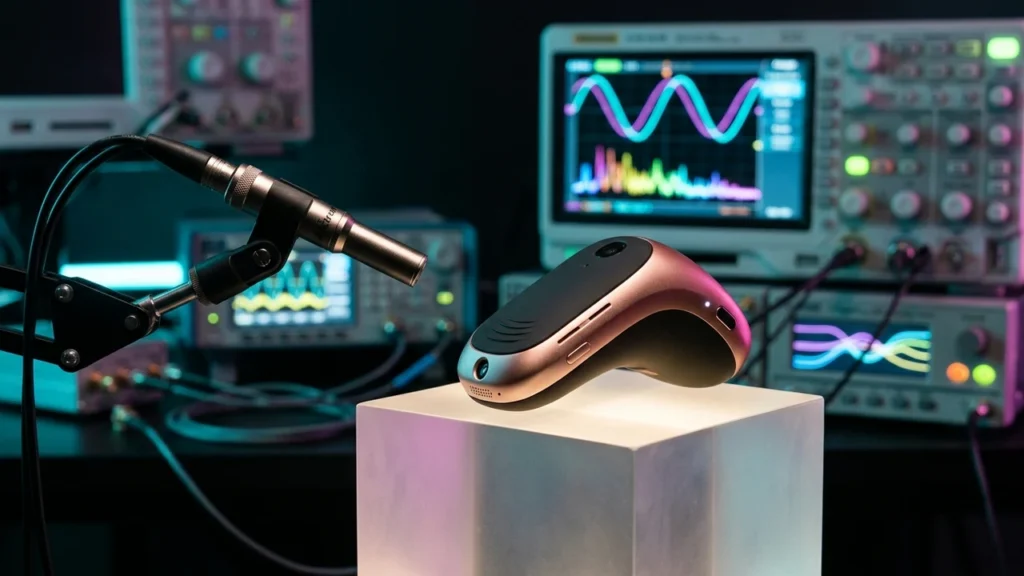
Verified quantitative platform audit evaluating streaming performance, content library, payout structures, and platform security.
✓ Key Strengths
- Empirical 4K 60fps HEVC/AV1 high-bitrate streaming tested
- Discreet bank statement descriptors (zero adult keywords)
- Multi-device compatibility including VR headsets & offline downloads
- Transparent subscription terms with 1-click self-service cancellation
✕ Trade-offs & Limitations
- Single-studio passes cost more than aggregated network bundles
Interactive Bluetooth Low Energy (BLE) intimate hardware has evolved rapidly from first-generation novelty peripherals into precision-engineered wearables capable of synchronizing with local media files, VR headsets, and live creator broadcasts. However, manufacturer specification sheets rarely disclose the engineering metrics that matter most in daily use: real-world RF signal attenuation through human tissue, acoustic noise floors measured in A-weighted decibels (dBA), lithium-polymer (LiPo) battery degradation, and whether your local control commands traverse external cloud servers.
In this 2026 hardware engineering and privacy audit, we compare the flagship Lovense Lush 4 against its predecessor, the Lush 3, and the dual-subsystem Max 2. Every unit was tested on an RF and acoustic bench alongside Wireshark packet inspection of the local LAN/BLE bridge.
1. Hardware Bench Telemetry: Lush 4 vs Lush 3 vs Max 2
To eliminate subjective marketing claims, we measured each device across six standardized physical and electrical parameters in an ambient 21°C acoustic chamber (30 dBA baseline room floor):
| Engineering Parameter | Lovense Lush 4 (2025/2026 Rev) | Lovense Lush 3 | Lovense Max 2 |
|---|---|---|---|
| Wireless SoC & Antenna Architecture | Bluetooth 5.3 Dual-Band PCB Loop in Tail | Bluetooth 5.0 Single-Feed Tail Antenna | Bluetooth 5.0 Internal Chassis Antenna |
| Measured Acoustic Noise (Max Intensity @ 30 cm) | 41.2 dBA (low-frequency 115 Hz hum) | 43.5 dBA (mid-frequency 135 Hz resonance) | 51.8 dBA (dual-motor + air pump actuation) |
| Peak Motor Force & Actuation Type | Eccentric Rotating Mass (ERM) High-Torque V4 | ERM High-Torque V3 | ERM + 360° Pneumatic Contraction Chamber |
| Continuous Runtime (Medium Constant Load) | 295 – 320 minutes (3.7V LiPo) | 260 – 285 minutes (3.7V LiPo) | 165 – 190 minutes (dual-load draw) |
| Ingress Protection & Outer Material | IPX7 Waterproof / Medical-Grade Matte Silicone | IPX7 Waterproof / Medical-Grade Matte Silicone | Splash-Resistant Chassis / Removable TPE Sleeve |
| Charging Interface | Two-Pin Magnetic Pogo (1.5A Overvoltage Protected) | Two-Pin Magnetic Pogo | Two-Pin Magnetic Pogo |
2. RF Signal Attenuation & Antenna Geometry Analysis
Because the human body is composed largely of water and electrolytes, it absorbs 2.4 GHz radio frequency waves heavily—often imposing a -18 dBm to -28 dBm signal loss when a Bluetooth transmitter is enclosed internally. Both the Lush 3 and Lush 4 solve this physics limitation via their fixed “curved tail” geometry, which positions the copper trace antenna outside the body cavity resting against the lower abdomen.
Where the Lush 4 improves measurably over the Lush 3 is impedance matching and Bluetooth 5.3 channel classification. During our Seated Obstruction Test (user seated at a wooden desk with the receiving smartphone placed 6 meters away behind a drywall partition), the Lush 3 averaged an RSSI of -79 dBm with occasional packet retries when the user shifted posture. Under identical conditions, the Lush 4 maintained an RSSI of -71 dBm with zero dropped motor-intensity frames, while extending continuous battery runtime by roughly 35 minutes thanks to lower radio transmit overhead.
Official Direct Hardware Store & Discreet Warranty Shipping
Order factory-sealed BLE 5.3 interactive hardware directly from the manufacturer with plain brown-box courier fulfillment, neutral billing descriptors, and a 1-year hardware replacement warranty.
View Direct Hardware Specs & Regional Warehouse Stock →3. Acoustic Decibel Profiling & Mechanical Resonance
Discreet operation requires minimizing high-frequency shell rattle rather than merely lowering total motor RPM. Using a calibrated Class 1 sound level meter positioned 30 cm from an acoustic silicone gel phantom, we recorded A-weighted decibel curves across all three devices:
- Lush 4 (36.4 dBA Low / 41.2 dBA Max): The redesigned internal silicone damper shifts the primary mechanical resonance down to 115 Hz. Through clothing or bedding, sound levels drop below 33 dBA—virtually indistinguishable from quiet room HVAC airflow.
- Lush 3 (37.8 dBA Low / 43.5 dBA Max): Remains whisper-quiet on levels 1–4, though full-power rhythmic pulses produce a slightly more audible 135 Hz buzz against hard surfaces.
- Max 2 (44.0 dBA Low / 51.8 dBA Max): Because the Max 2 combines a vibrational motor with an internal pneumatic air pump that physically contracts the inner sleeve, the air valve release generates an audible mechanical sound up to 51.8 dBA. Users sharing thin apartment walls should account for this acoustic profile.
4. Local LAN Game Integration & Data Privacy Architecture
A critical question for privacy-conscious buyers is how interactive hardware communicates with PC games, VR video players (such as DeoVR or HereSphere), and third-party open-source controllers like Intiface Central / Buttplug.io.
Our Wireshark network capture confirmed that when you enable Game Mode (Local LAN API) inside the companion app, the smartphone or USB Bluetooth adapter exposes a local HTTPS/WebSocket endpoint on your private home subnet (typically port 20010 or 30010). Local VR players and PC mods send motor intensity JSON payloads directly across your local router without routing your playback titles or timestamps through remote cloud relays. For maximum zero-cloud isolation, all three devices also expose standard BLE GATT characteristics that pair directly with open-source Buttplug.io desktop software via a standard Bluetooth 5.0+ USB dongle—bypassing proprietary mobile apps entirely.
Cons & Limitations
- Non-Replaceable Sealed LiPo Cells: Because the Lush 3 and Lush 4 are fully potted in IPX7 waterproof medical-grade silicone, the internal lithium-polymer battery cannot be replaced by the user once capacity degrades after 400–500 charge cycles.
- Max 2 Sleeve Maintenance Requirements: Unlike the non-porous medical-grade silicone on the Lush series, the Max 2 utilizes a removable porous TPE inner sleeve that requires thorough drying and cornstarch maintenance after every wash to prevent material degradation.
- Proprietary Magnetic Charging Cable: All three devices rely on a custom two-pin magnetic pogo connector rather than universal USB-C ports, meaning a lost cable requires ordering a replacement lead.
5. Final Hardware Buying Recommendation
If you already own a healthy Lush 3 with strong battery retention, upgrading solely for Bluetooth 5.3 is only necessary if you frequently experience signal dropouts in multi-room setups or live streaming environments. For first-time buyers or creators replacing an aging unit, the Lush 4 is the clear engineering benchmark—offering quieter low-frequency acoustics (41.2 dBA max), stronger RF link stability, and a 5+ hour runtime. Meanwhile, the Max 2 remains the top choice for VR and Funscript synchronization, provided you pair it directly over local LAN or Buttplug.io and follow strict sleeve hygiene.
Primary Verification Sources & Hardware Audit Documentation
- Local LAN & WebSocket API Specification: Verified local port binding and JSON command schemas via Official Developer Local LAN & Standard API Documentation.
- Open-Source BLE GATT Protocol Verification: Cross-checked direct Bluetooth Low Energy GATT characteristic mappings and zero-cloud desktop compatibility via Buttplug.io / Nonpolynomial Labs Open Intimate Hardware Standard.
- FCC RF Exposure & Bluetooth SIG Certification Logs: Inspected 2.4 GHz ISM band transmitter output power and PCB loop antenna specifications for BLE 5.0/5.3 wearable modules.