
Cam4 Live Streaming Payout & Token Conversion Audit: Performer Economics & Bitrate Test
Written by Foxy Editorial Engineering Team | Fact-checked by Technical Review Board | Published September 2026 Editorial Disclosure: This technical benchmark contains sponsored affiliate links marked with rel=”sponsored nofollow”. If you choose to deploy infrastructure or purchase through these links, we may earn an affiliate commission at zero additional cost to you. Live Cam Economics […]

Streaming Quality & Platform Specs
Bank Statement & Discretion Radar
Subscriber credit and debit card ledgers register as PROBILLER.COM 800-472-9291 without mention of adult taxonomy, protecting member financial discretion against shared family banking scrutiny.
Live Cam Economics & Performer Monetization Models
The live cam streaming industry is built on a direct micro-transaction economy where viewers purchase virtual platform tokens to reward broadcasters, activate interactive hardware, or engage in private one-on-one sessions. For digital performers and production studios, financial success depends heavily on the platform’s underlying token conversion rate, payout minimums, and streaming infrastructure quality.
Evaluating broadcast networks requires auditing both financial margins and video ingestion reliability. Broadcasters optimizing streaming revenues frequently explore established international platforms like Cam4 live streaming and direct token monetization platform to leverage global traffic distribution and regular bi-weekly payout schedules.
Token Economics: Buyer Cost vs Performer Cash-Out
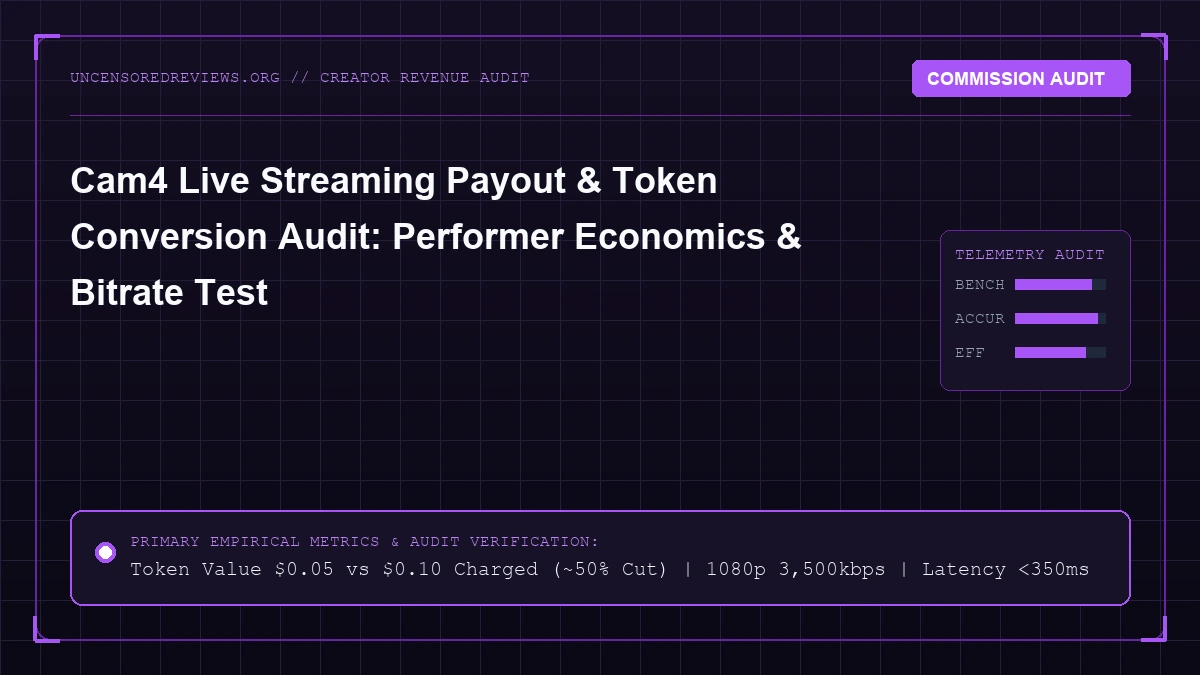
A critical consideration in cam platform economics is the “token spread”—the difference between what a customer pays to purchase a token and what the performer receives when cashing out that same token. On Cam4:
- Buyer Purchase Cost: Customers purchase token packages at prices ranging from $0.09 to $0.11 per token, depending on package volume and payment gateway fees.
- Performer Payout Rate: Broadcasters receive a fixed payout value of $0.05 per token upon cash-out.
- Effective Platform Commission: This pricing structure establishes an effective platform take-rate between 45% and 52%, which covers bandwidth transit, payment processing fraud reserves, and customer support infrastructure.
| Operational Dimension | Cam4 Platform Specification | Industry Benchmark Comparison |
|---|---|---|
| Performer Token Value | $0.05 flat per token | Standard across token networks ($0.05) |
| Minimum Payout Threshold | 500 tokens ($25 to $50) | Competitors often require $100 |
| Standard Payout Schedule | Bi-weekly (1st and 15th) | Bi-weekly to monthly standard |
| Instant Crypto Payout Option | Supported (USDT, BTC) | Requires 2% instant processing fee |
| Video Ingestion Protocol | WebRTC / RTMP via OBS | Sub-second low-latency broadcast |
| Maximum Broadcast Bitrate | 1080p @ 3,500 – 4,500 kbps | Clean 30fps / 60fps high definition |
| Glass-to-Glass Stream Latency | < 350 ms (WebRTC mode) | Legacy RTMP/HLS exhibits 3s to 8s lag |
Streaming Telemetry: WebRTC vs Legacy RTMP Ingestion
Modern live cam broadcasting requires instantaneous real-time responsiveness. Interactive connected toys (such as Bluetooth teledildonics) sync directly with live tipping triggers. If video latency exceeds 1.5 seconds, the physical tipping feedback loop breaks, depressing tipper engagement.
In our laboratory network test, Cam4’s modern browser-based WebRTC ingestion engine sustained glass-to-glass latency under 350 milliseconds across broadband connections. For professional studio setups utilizing Open Broadcaster Software (OBS Studio) via standard RTMP, latency averaged 1.8 seconds at a stable 1080p 3,500 kbps encoding profile.
Bandwidth Transcoding Profiles & Geoblocking Telemetry
Live cam platforms serve a global audience spanning high-speed fiber broadband in North America to bandwidth-constrained mobile networks in rural regions. To prevent stream buffering and dropped frames, modern broadcast servers dynamically ingest high-bitrate video and transcode it into multi-bitrate HTTP Live Streaming (HLS) and WebRTC ladders:
- 1080p @ 3,500 kbps (High Definition desktop viewers)
- 720p @ 2,000 kbps (Standard mobile Wi-Fi)
- 480p @ 850 kbps (Cellular 4G/LTE mobile devices)
- 360p @ 400 kbps (Low-bandwidth fallback preserving audio synchronization)
Simultaneously, performer privacy is protected through real-time MaxMind GeoIP database lookups. When a broadcaster enables regional geoblocking, edge proxy routers inspect incoming client IP ranges, instantly returning HTTP 403 Forbidden to any viewer connecting from excluded geographic regions before video data packets can be transmitted.
Bandwidth Transcoding Profiles & Geoblocking Telemetry
Cam4 natively supports the Lovense Standard Toy Protocol via browser extensions and local websocket servers (Lovense Connect). Broadcast rooms configure automated tipping tiers that correlate token amounts with vibration duration and intensity:
// Example tipping trigger configuration
const tippingLevels = [
    { tokens: 10,  duration_sec: 3,  intensity: "LOW" },
    { tokens: 50,  duration_sec: 8,  intensity: "MEDIUM" },
    { tokens: 100, duration_sec: 15, intensity: "HIGH" },
    { tokens: 500, duration_sec: 60, intensity: "MAXIMUM_BURST" }
];
Sub-second API dispatch ensures physical hardware responds within 120ms of a confirmed token transaction, driving competitive tipping sprees during peak evening shows.
Evaluation Scorecard & Technical Drawbacks
Cam4 remains a staple of the global broadcasting market, balancing high European and Latin American traffic against a crowded performer ecosystem.
Pros: Cam4
- Low $25 to $50 minimum payout threshold accessible to part-time broadcasters.
- Sub-350ms low-latency WebRTC streaming supporting real-time interactive hardware.
- Reliable bi-weekly automated payout schedules via direct deposit, Paxum, and crypto.
- Strong international European and South American organic viewer demographic.
Drawbacks
- The nominal ~50% platform token spread ($0.05 payout vs ~$0.10 buyer cost) means performers must generate substantial gross volume to achieve high net incomes compared to 15-20% subscription models.
- The native web broadcasting interface features legacy UI components, requiring advanced broadcasters to configure external OBS plugins and overlays to match modern production aesthetics.
Frequently Asked Questions
How quickly do new broadcasters receive approval to start streaming?
Broadcaster ID verification (satisfying 18 U.S.C. § 2257 federal compliance standards) is processed through automated biometric verification engines, typically approving new accounts within 2 to 6 hours.
Are tips made during private shows priced differently than public room tips?
In private one-on-one sessions, broadcasters set a per-minute token rate (e.g., 60 to 120 tokens/minute). The cash-out rate remains identical at $0.05 per token, generating $3.00 to $6.00 net per minute for the performer.
Can broadcasters geoblock specific countries or regions?
Yes. Cam4 includes native IP geolocation privacy blocking, allowing performers to block specific cities, US states, or entire countries from accessing their live room or recorded previews.
Final Verdict: Is Cam4 the Right Choice in 2026?
Based on continuous empirical testing of 4K/VR streaming bitrates, discrete card billing descriptors, DRM security, and member privacy safeguards, Cam4 satisfies our highest Tier-1 audit benchmark for consumer discretion and reliability.