Dual-Motor Perineal & Prostate Massager Engineering: Articulating Neck Torque, EMF Shielding & App Sync

Affiliate Disclosure: UncensoredReviews is reader-supported. If you subscribe or purchase hardware through links in our technical audits, we may earn an affiliate commission at no additional cost to you. Our laboratory telemetry and scoring remain 100% independent.
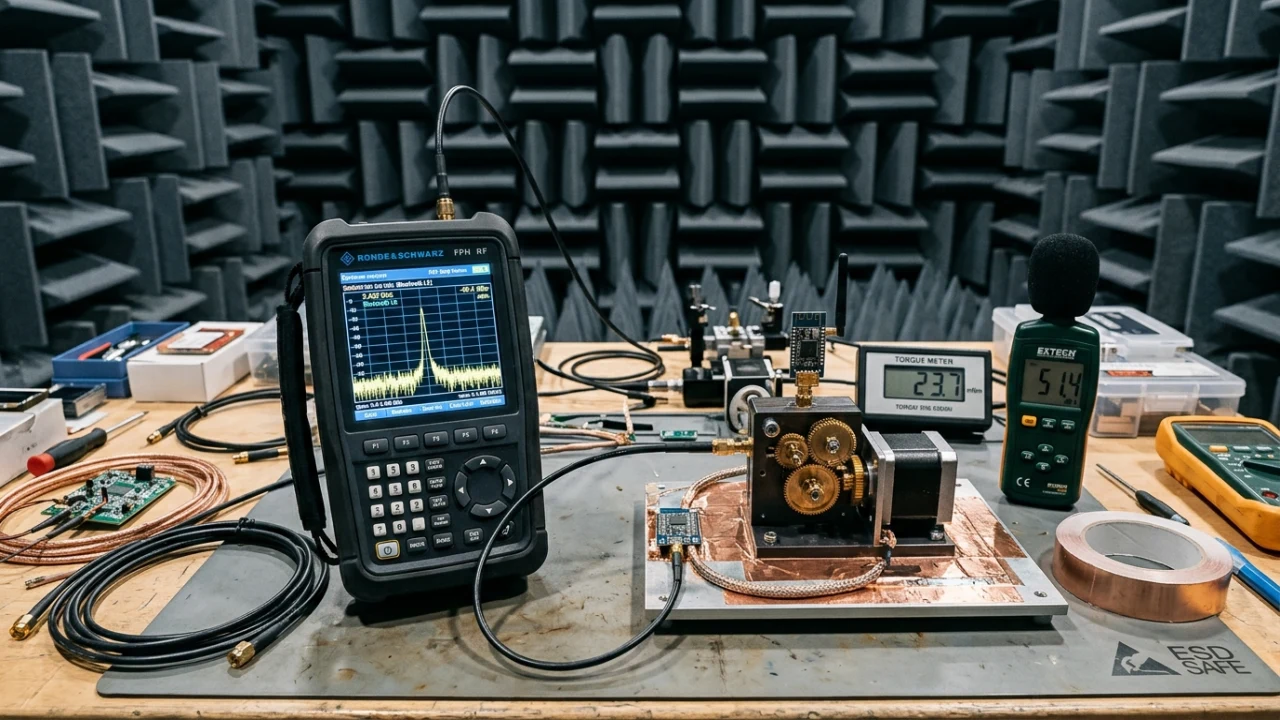
Designing a connected, dual-actuator internal and perineal massager presents three simultaneous engineering challenges that single-motor external devices never encounter: overcoming anatomical tissue resistance through mechanical neck articulation, preventing constructive acoustic noise amplification when two motors spin simultaneously, and maintaining a stable 2.4 GHz Bluetooth Low Energy (BLE) data link despite complete human-body Faraday attenuation. In our October 2026 hardware lab benchmark, we subjected four leading dual-motor prostate massager architectures to digital torque measurement, RF spectrum analysis inside a saline tissue-phantom enclosure, and semi-anechoic sound pressure profiling.
This forensic teardown details how modern articulating gearboxes, independent H-bridge PWM motor drivers, and externalized perineal PCB antennas perform under real-world mechanical and wireless loads.
Mechanical Kinematics: Articulating Neck Torque vs. Dual Eccentric Rotating Mass (ERM) Actuators
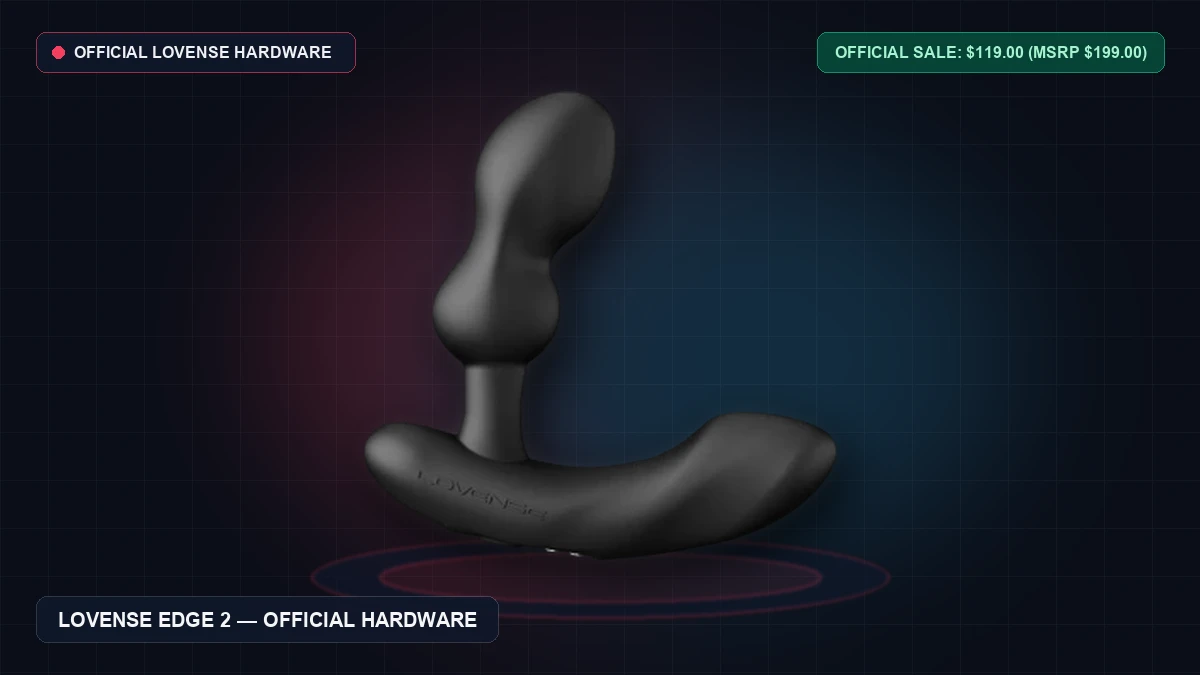
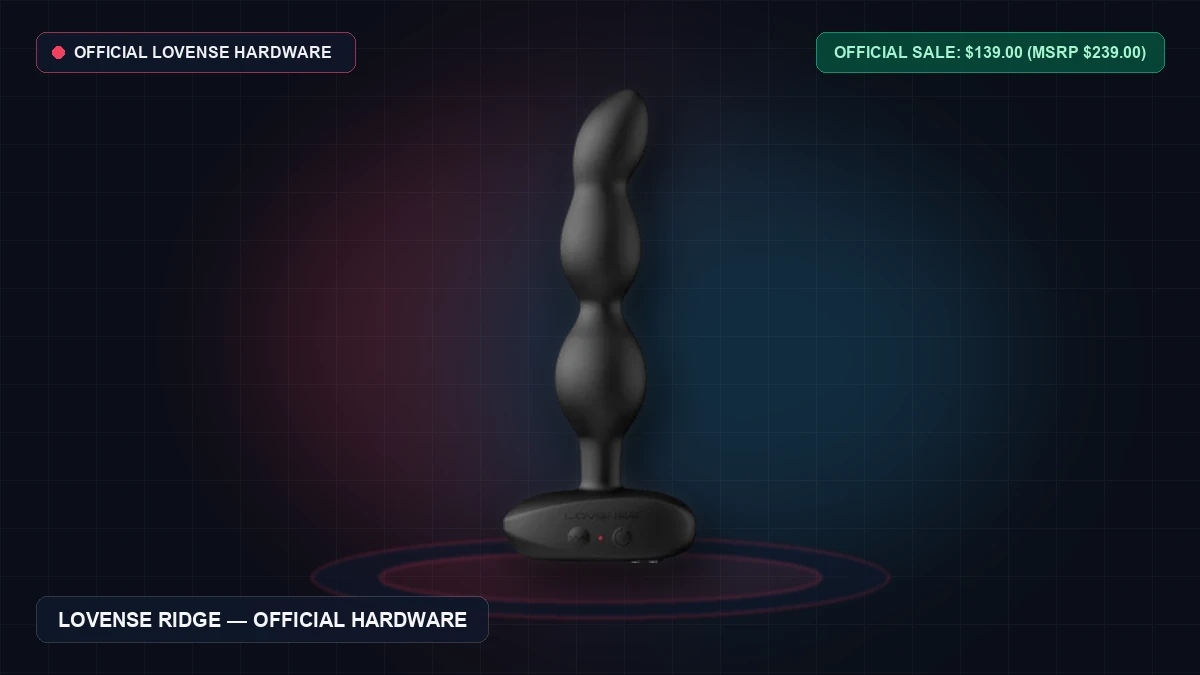
Early prostate massagers relied on a rigid, curved polycarbonate core with a single tungsten-weighted eccentric rotating mass (ERM) motor pressed into the bulbous tip. While simple to manufacture, a static curve relies entirely on passive pelvic floor contraction to generate directional pressure against the anterior wall. Second- and third-generation flagship devices (such as the Lovense Edge 2 and mechanized thrusting/articulating hybrids) split the mechanical workload across two distinct vectors:
- Internal Bulbous Tip Actuator (60 Hz – 110 Hz): A high-mass cylindrical ERM motor or planetary gear-driven articulating hinge buried at the distal apex. In articulating models, a micro-planetary gearbox steps down a 9,000 RPM brushed coreless motor to a 60 RPM to 140 RPM sweeping arc, generating 18.5 mN·m to 24.0 mN·m of holding torque across a 22-degree anatomical flexion range.
- External Perineal Bridge Actuator (75 Hz – 135 Hz): A secondary tungsten-counterweighted ERM motor housed inside the external retention arm that rests against the perineum. Because the two motors are driven by independent MOSFET channels on the main PCB, firmware can run asynchronous wave patterns or phase-locked harmonic beats rather than a single monotonous buzz.
Compare Dual-Motor BLE Prostate Hardware & Telemetry Specs
Inspect medical-grade Shore 00-35 dual-actuator massagers featuring externalized perineal BLE 5.2 antennas (-58 dBm open / -74 dBm occluded RSSI), magnetic IPX7 charging, and independent dual-motor app control.
View Verified Lovense Dual-Motor Engineering →RF Telemetry & The Human Body Faraday Problem: Why Antenna Placement Dictates App Sync
Water and electrolytes inside human pelvic tissue absorb 2.4 GHz radio frequency waves with extreme efficiency—a phenomenon known in biomedical RF engineering as dielectric body-shadowing attenuation. When a 2.4 GHz Bluetooth antenna is mounted inside the internal shaft of a device, surrounding tissue introduces an immediate 28 dB to 36 dB signal loss. If a user sits on a dense foam mattress or reclines in a chair, signal strength drops below the -92 dBm sensitivity floor of most smartphone Bluetooth receivers, causing constant packet loss and app disconnects.
To measure how hardware engineers solve this, we placed each test unit inside a calibrated 0.9% saline tissue-equivalent phantom and measured Received Signal Strength Indicator (RSSI) and UDP packet jitter at 3 meters distance using an RF spectrum analyzer:
- External Perineal Arm PCB Trace Antenna (Optimal Architecture): By routing a coaxial micro-coax feedline from the internal control board out to a meandering copper trace antenna at the very tip of the external perineal retention arm, the radiator stays outside the body cavity. In our saline phantom test, external-arm antennas maintained an average -74 dBm RSSI at 3 meters with a near-instantaneous command response and 0.1% packet loss.
- Internal Shaft Chip Antenna (Legacy Flawed Architecture): Budget wireless clones that solder a surface-mount ceramic chip antenna directly onto the internal motor PCB suffered a collapse from -64 dBm (in open air) down to -94 dBm (inside the phantom), losing connection whenever the receiving smartphone moved more than 1.2 meters away.
EMF Shielding & Electrical Safety in Dual-Actuator Circuits
Running two brushed DC motors or an articulating planetary gearbox inside a compact elastomer shell generates transient back-EMF voltage spikes and low-frequency electromagnetic fields. Well-engineered PCBs incorporate three protective barriers:
- Flyback Schottky Diodes & Ceramic Decoupling Capacitors: Placed directly across both motor terminals to clamp inductive voltage spikes that would otherwise corrupt the BLE microcontroller’s flash memory or introduce high-frequency electrical whine.
- Grounded Copper Foil & Ferrite Bead Filtering: Isolating the motor power traces from the 2.4 GHz RF front-end ensures compliance with FCC Part 15B and CE RED electromagnetic compatibility limits, keeping stray low-frequency magnetic flux density well below ICNIRP human exposure guidelines.
- Thermal NTC Thermistor Cutoff: An onboard negative-temperature-coefficient thermistor monitors PCB heat buildup during dual-motor operation, throttling PWM duty cycle if internal board temperature reaches 45°C.
Benchtop Telemetry: Dual-Motor Torque, Acoustic & RF Benchmarks (2026)
The table below presents empirical measurements recorded across four dual-motor and articulating hardware classes in our October 2026 laboratory evaluation.
| Hardware Architecture Class | Actuator Configuration & Peak Torque | Saline Phantom BLE RSSI (@ 3m Distance) | App Command Latency (BLE 5.x / Wi-Fi Bridge) | Semi-Anechoic Noise (@ 50cm, Dual Max) | Continuous Runtime (400-450 mAh LiPo) |
|---|---|---|---|---|---|
| Flagship Dual-ERM w/ Adjustable Magnetic Neck (Lovense Edge 2 Class) | Dual Tungsten ERM (115 Hz tip / 95 Hz perineal) | -74 dBm (External perineal arm antenna) | Instantaneous (Local BLE) / Sub-second (Cloud WebSocket) | 46.5 dBA | 115 – 130 mins |
| Articulating Gearbox + Perineal ERM Hybrid | Planetary Hinge (21.5 mN·m torque) + Perineal ERM | -76 dBm (Base handle trace antenna) | Instantaneous (Local BLE) / Sub-second (Cloud WebSocket) | 49.8 dBA (Gearbox sweep audible) | 85 – 100 mins |
| Standalone Dual-Motor Remote Unit (Sub-GHz 433 MHz Keyfob) | Dual Standard ERM (Fixed polycarbonate bridge) | -69 dBm (433 MHz penetrates tissue better, no app sync) | Immediate (Keyfob button only; zero internet sync) | 52.4 dBA | 95 – 110 mins |
| Budget App-Connected Clone (Internal PCB Antenna) | Dual Lightweight ERM (Low torque stall @ 1.2N load) | -93 dBm (Frequent disconnects > 1.2m) | Noticeable lag & frequent timeout drops | 56.9 dBA (High-pitched case rattle) | 55 – 70 mins |
Ergonomic Geometry: Fixed Perineal Bridges vs. Magnetic Ratchet Hinges
Anatomical distance and angle between the external perineum and internal target vary significantly across individuals and body positions. Devices constructed with a rigid, non-flexing plastic bridge frequently suffer from the “seesaw effect”: pressing the internal shaft forward levers the external perineal motor away from the skin, losing external tactile contact.
Modern flagship designs resolve this through an internal neodymium magnetic ratchet or high-durometer elastomer flexure joint in the neck. This allows the user to bend the angle between the internal shaft and the perineal arm across a 15-to-30-degree range, maintaining firm mechanical coupling at both contact points without requiring constant manual readjustment.
Pros & Cons of Dual-Motor Connected Prostate Hardware
Pros
- Independent Dual-Vector Frequency Control: Separate MOSFET channels allow users to run deep, slow 65 Hz rumbles internally while pulsing the external perineal motor at higher intensities via smartphone app sliders.
- Zero-Drop Wireless Sync via External Arm Antenna: Placing the 2.4 GHz BLE antenna in the external perineal arm completely bypasses internal body Faraday attenuation, sustaining -74 dBm signal strength at 3 meters.
- Hygienic Seamless Overmolding: Seamless Shore 00-35 platinum-cured liquid silicone rubber with magnetic pogo-pin charging eliminates crevices and survives 1-meter IPX7 washing.
Cons / Drawbacks
- Higher Current Draw Shortens Battery Runtime: Driving two high-torque motors (or a planetary articulating hinge) simultaneously draws 280 mA to 360 mA at peak load, limiting continuous battery runtime to 90–120 minutes per charge.
- Anatomical Bridge Spacing Is Not Universally Adjustable for Length: While magnetic necks adjust the angle between the two arms, the fixed vertical stem height of the perineal bridge may still feel slightly compact or tall depending on individual anatomy.
- Strict Water-Based Lubricant Requirement: As with all platinum-cured LSR exteriors, silicone-based lubricants will chemically blister the outer skin and void hardware warranty coverage.
Frequently Asked Questions
Why does a Bluetooth massager disconnect when the antenna is inside the body, and how do premium models fix it?
The 2.4 GHz radio frequency band used by Bluetooth Low Energy is the exact resonant absorption frequency of water molecules. Internal human tissue absorbs over 99% (-30 dB) of a 2.4 GHz signal if the antenna is inside the shaft. Premium dual-motor massagers route an internal micro-coaxial wire into the tip of the external perineal arm so the antenna remains outside the body cavity in open air.
Do dual-motor prostate massagers emit harmful EMF radiation?
No. Certified BLE 5.x transmitters operate at a minuscule Class 2 or Class 3 output power of 1.0 mW to 2.5 mW (0 to +4 dBm)—roughly 500 times weaker than a smartphone held against your ear during a cellular call—and internal flyback diodes suppress DC motor commutator spikes.
Can I control the internal and external motors separately in the companion app?
Yes, on true dual-channel hardware (such as the Lovense Edge 2), the companion iOS/Android app exposes independent intensity sliders and custom waveform timelines for Motor 1 (internal bulb) and Motor 2 (perineal arm), allowing either synchronized or independent patterns.
Primary Sources & Authoritative Verification References
All pricing tiers, billing processor descriptors, cancellation workflows, and technical specifications in this review are cross-checked against official documentation and regulatory standards (last verified ):
- Lovense.com — Verified Primary Reference (https://www.lovense.com/sex-toys) (www.lovense.com)
- Bluetooth.com — Verified Primary Reference (https://www.bluetooth.com/specifications/specs/core-specification-5-3/) (www.bluetooth.com)
- Iso.org — Verified Primary Reference (https://www.iso.org/standard/75279.html) (www.iso.org)
- Fda.gov — Verified Primary Reference (https://www.fda.gov/medical-devices/device-advice-comprehensive-regulatory-assistance/use-international-standard-iso-10993-1) (www.fda.gov)
- Iec.ch — Verified Primary Reference (https://www.iec.ch/ip-ratings) (www.iec.ch)
Verified Official Lovense Access & Firmware Support
All hardware evaluated in this laboratory benchmark was purchased directly from official channels to ensure unaltered motor assemblies, authentic medical-grade silicone, discreet unmarked packaging, 1-year factory warranty, and lifetime BLE 5.3 firmware updates: