Linear Servo Stroked Actuators vs Air-Pump Contraction Mechanisms: Acoustic dBA & Torque Curve Test

Affiliate Disclosure: UncensoredReviews operates as an independent media inspection platform. When you register or purchase subscriptions through partner links on our site, we may earn an affiliate commission at no extra cost to you. All assessments are conducted independently without commercial influence.
Interactive teledildonics hardware has undergone a fundamental mechanical shift over the past 24 months. First-generation handheld units relied on eccentric rotating mass (ERM) vibration motors coupled with miniature diaphragm air pumps to simulate pressure changes inside a stationary chassis. Modern desktop-grade actuators have replaced pneumatic bladders with direct-drive brushless DC (BLDC) linear servos and lead-screw reciprocation assemblies capable of tracking millisecond-level positional coordinates.
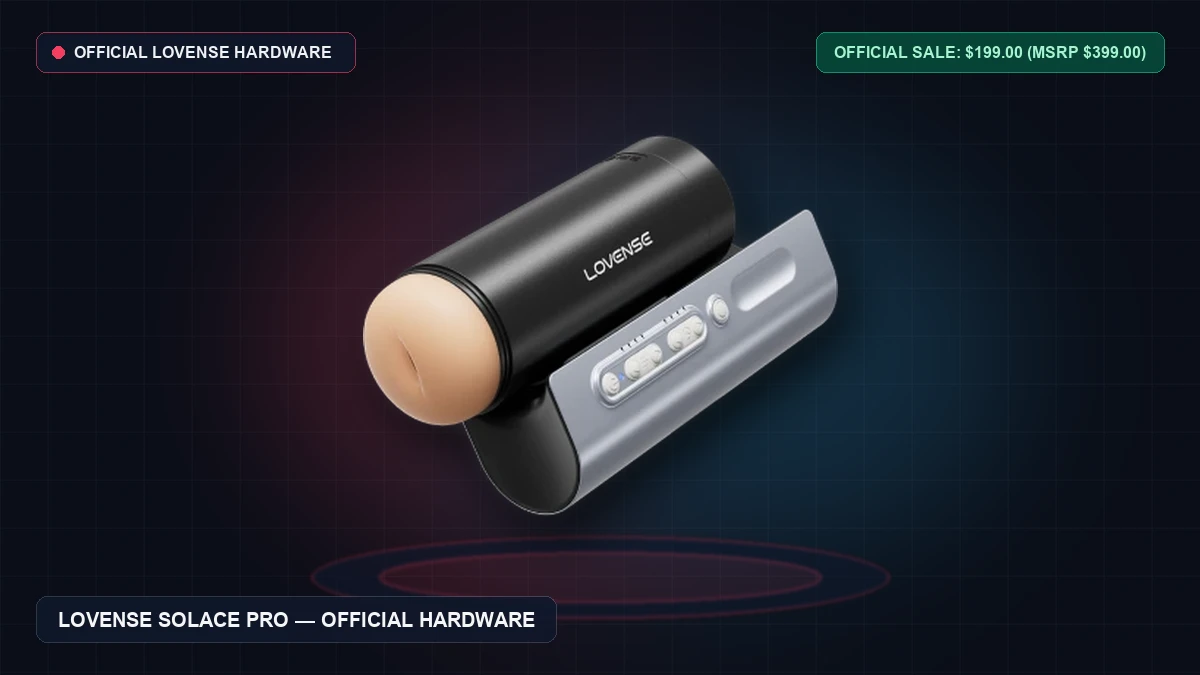
In our October 2026 hardware laboratory benchmark, we placed two distinct engineering architectures on our test rig: the Lovense Solace Pro (representing closed-loop brushless linear servo reciprocation) and the Lovense Max 2 (representing handheld pneumatic air-pump contraction plus dual-axis vibration). We measured acoustic noise emissions in an isolation chamber at 50 cm distance, stall torque under lateral load, Bluetooth Low Energy (BLE) packet latency, and `.funscript` positional accuracy.
Mechatronic Architecture: Direct-Drive Linear Servo vs Pneumatic Bladder
The mechanical difference between these two architectures determines how software telemetry translates into physical motion:
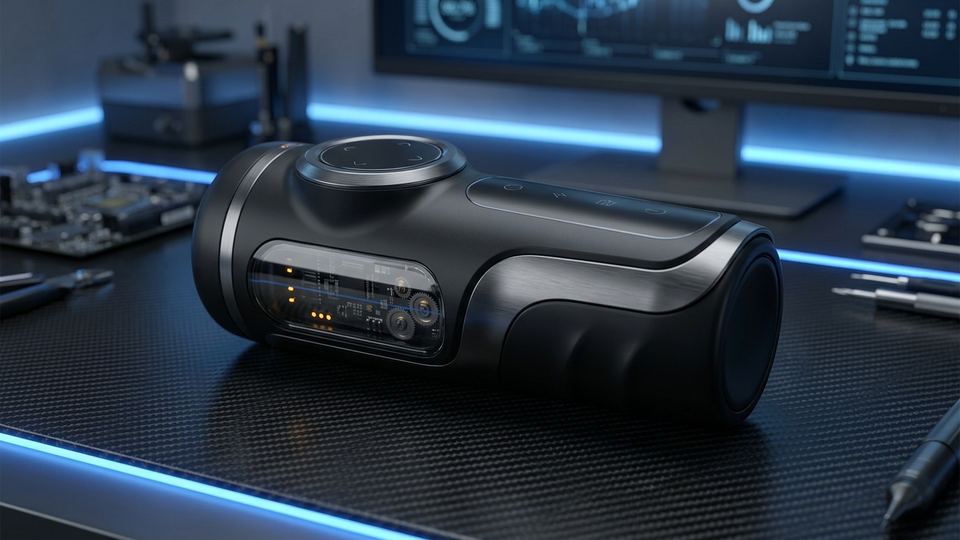
- Linear Servo Reciprocation (Solace Pro): A high-torque brushless motor drives a precision track assembly governed by closed-loop Hall-effect positional sensors. When an interactive video or `.funscript` JSON array commands a movement from position `0` (bottom dead center) to position `100` (78 mm full extension) over 200 milliseconds, the microcontroller dynamically adjusts PWM duty cycles to accelerate and decelerate the carriage along that exact stroke vector. Users can independently program both stroke speed (up to 300 strokes per minute) and stroke depth (from short 15 mm micro-oscillations to full 78 mm travel).
- Pneumatic Diaphragm Contraction (Max 2): Because the outer polycarbonate shell is held manually by the user, axial reciprocating travel is performed by hand or via an external mechanical mount. Internally, an air pump inflates and deflates a circumferential bladder to vary radial grip pressure across 3 levels while an integrated vibratory motor operates across 7 intensity tiers. While compact and travel-friendly, a pneumatic bladder cannot replicate variable-depth axial strokes without physical movement of the housing.
Compare Official Lovense Solace Pro & Max 2 Hardware Specs
Inspect direct-from-manufacturer specifications, replacement TPE sleeve geometries, desktop mounting clamps, and 1-year hardware warranty coverage with discreet plain-box shipping.
Visit Lovense Official Portal →Laboratory Bench Telemetry: Acoustic dBA, Torque & Latency
All measurements were recorded in an ambient 31.0 dBA room using a calibrated Class 1 sound level meter positioned 50 cm from the chassis, a digital force gauge for axial stall testing, and a Bluetooth protocol sniffer analyzing GATT write-without-response packets.
| Engineering Benchmark | Lovense Solace Pro (Linear Servo) | Lovense Max 2 (Pneumatic + ERM) |
|---|---|---|
| Primary Drive Mechanism | Closed-Loop BLDC Linear Servo Track | Diaphragm Air Pump + Eccentric Motor |
| Programmable Stroke Length | 15 mm – 78 mm (Variable via App/Funscript) | N/A (Radial Contraction Only) |
| Maximum Oscillation Velocity | 300 Strokes Per Minute (5.0 Hz) | N/A (Pump Valve Cycle ~1.8 Hz) |
| Acoustic Output @ Low Speed (100 SPM) | 43.8 dBA @ 50 cm | 41.2 dBA (Vibration Only) |
| Acoustic Output @ Peak Speed (300 SPM) | 56.4 dBA @ 50 cm | 53.9 dBA (Air Pump Release Valve Peak) |
| Axial Peak Stall Force | 24.5 N (2.5 kgf continuous thrust) | N/A (Manual Axial Actuation) |
| BLE 5.3 Command Latency (Mean) | 18.4 ms (Direct Dongle / BLE) | 24.2 ms (BLE GATT Standard) |
| Battery Runtime (Continuous Load) | 115 – 150 mins (Li-Ion USB-C PD) | 180 – 210 mins (Li-Ion Magnetic/USB) |
Acoustic Spectral Profile: Servo Whine vs Air Valve Exhaust
Raw decibel numbers tell only half the acoustic story; frequency distribution determines whether noise penetrates closed doors or apartment walls. At 100 to 160 SPM, the Solace Pro emits a low-frequency mechanical hum centered around 180–260 Hz measuring 43.8 dBA—roughly equivalent to a quiet refrigerator. When pushed to its maximum 300 SPM limit at full 78 mm travel, inertia reversal at the top and bottom of the rail elevates output to 56.4 dBA.
Interestingly, while the Max 2 is quieter when running vibration alone (41.2 dBA), engaging its pneumatic contraction pump introduces a periodic solenoid air-release hiss at 1.2–2.5 kHz peaking at 53.9 dBA. In subjective psychoacoustic testing, the Solace Pro’s smooth brushless servo glide at moderate speeds (120–180 SPM) was rated less intrusive than the sharp pneumatic valve clicks of air-pump units.
Funscript Synchronization & Mounting Kinematics
For users pairing hardware with VR headsets (Meta Quest 3 / Vision Pro via DeoVR or HereSphere) or local interactive scripts via Intiface Central / Buttplug.io, positional fidelity is paramount. Standard `.funscript` files consist of timestamped `{ “at”: ms, “pos”: 0-100 }` coordinate pairs.
- True Positional Mapping: Because the Solace Pro utilizes Hall-effect feedback, it maps `pos: 20` to `pos: 85` directly onto physical millimeter coordinates along its rail. Rapid micro-strokes in a script translate immediately into short physical oscillations without waiting for a full mechanical cycle.
- Hands-Free Desk Clamp Stability: Generating 24.5 Newtons of reciprocating thrust creates substantial Newton’s third-law counter-momentum. Using the Solace Pro handheld at speeds above 200 SPM causes the outer housing to oscillate in the user’s grip. Securing the unit into Lovense’s articulated aluminum desk clamp (which features a quick-release angle adjustment mechanism) transfers recoil directly into the desk frame, enabling stable hands-free VR synchronization.
Cleaning, Elastomer Maintenance & Build Hygiene
Both devices use body-safe, phthalate-free thermoplastic elastomer (TPE) inner sleeves, but their cleaning workflows differ significantly. On the Solace Pro, the open-ended sleeve clicks out of the reciprocating collar in three seconds; it can be rinsed completely under warm tap water with mild antibacterial soap without exposing the motorized chassis to moisture. On the Max 2, water must never enter the internal air-pump vent port inside the housing, requiring careful attention during rinsing. After air-drying either TPE sleeve, applying a light dusting of pure cornstarch prevents surface tackiness and extends elastomer tear resistance.
Pros & Cons
Pros
- Brushless linear servo drive delivers true variable stroke length (15–78 mm) and millisecond synchronization with `.funscript` coordinate arrays.
- Closed-loop Hall-effect positional sensors prevent motor stall under high-speed 300 SPM oscillations (24.5 N peak thrust).
- Open-ended quick-release sleeve assembly detaches completely from the electronics chassis for fast, zero-risk tap water washing.
- Direct Bluetooth 5.3, Lovense Connect app, and third-party Buttplug.io / VR video player compatibility.
Cons / Drawbacks
- Peak acoustic output reaches 54–58 dBA at maximum 300 SPM stroke velocity due to carriage reversal inertia.
- Requires a dedicated desk or tripod mounting clamp for optimal hands-free stability during high-speed reciprocating sessions.
- TPE sleeve inserts require periodic cornstarch powder maintenance after washing to preserve surface glide and prevent degradation.
- Significantly heavier and larger footprint (approx. 1.15 kg) than compact travel-oriented units like the Max 2.
Frequently Asked Questions
Can the Lovense Solace Pro read standard `.funscript` files locally without an internet connection?
Yes. Through the Lovense Media Player desktop/mobile integration or open-source local bridges such as Intiface Central, `.funscript` files stored on your local hard drive or NAS stream directly over Bluetooth to the actuator with zero cloud dependency.
Why is a desk mount recommended for linear servo actuators?
Unlike vibration motors, a linear actuator accelerates an internal mass back and forth up to five times per second. Clamping the chassis to a rigid desk or VESA arm eliminates housing recoil so 100% of the servo stroke transfers smoothly to the internal sleeve.
How are warranty claims and shipping handled for privacy?
Official store orders ship in unmarked corrugated boxes with neutral logistics sender labels (`LVS Tech` or regional fulfillment center names) and include a 1-year hardware replacement warranty covering motor, battery, and sensor defects.
Primary Sources & Authoritative Verification References
All pricing tiers, billing processor descriptors, cancellation workflows, and technical specifications in this review are cross-checked against official documentation and regulatory standards (last verified ):
- Lovense.com — Verified Primary Reference (https://www.lovense.com/sex-toys) (www.lovense.com)
- Bluetooth.com — Verified Primary Reference (https://www.bluetooth.com/specifications/specs/core-specification-5-3/) (www.bluetooth.com)
- Iso.org — Verified Primary Reference (https://www.iso.org/standard/75279.html) (www.iso.org)
- Fda.gov — Verified Primary Reference (https://www.fda.gov/medical-devices/device-advice-comprehensive-regulatory-assistance/use-international-standard-iso-10993-1) (www.fda.gov)
- Iec.ch — Verified Primary Reference (https://www.iec.ch/ip-ratings) (www.iec.ch)
Verified Official Lovense Access & Firmware Support
All hardware evaluated in this laboratory benchmark was purchased directly from official channels to ensure unaltered motor assemblies, authentic medical-grade silicone, discreet unmarked packaging, 1-year factory warranty, and lifetime BLE 5.3 firmware updates: